
How to Identify Overloaded Circuits at Home

The kettle clicks on, the microwave starts, and suddenly half the kitchen goes dark. Knowing how to identify overloaded circuits can help you act early, before a nuisance trip becomes damaged wiring, a failed appliance or a genuine fire risk. For Perth homes and businesses, the signs are often easy to spot once you know what you are looking for.
An overloaded circuit means more electrical demand is being placed on one circuit than it is designed to carry. Modern switchboards are built to protect against this by shutting the circuit down. That protection is useful, but repeated tripping is not something to ignore or work around.
What an overloaded circuit looks like
The clearest sign is a circuit breaker that trips when particular appliances run at the same time. You may notice it when the heater, clothes dryer and iron are on together, or when a workshop runs several power tools from nearby outlets. In a business, it may happen when kitchen equipment, computers, printers or portable air conditioning units share too few circuits.
A single trip does not automatically mean an overload. A faulty appliance, moisture in an outlet, damaged wiring or an earth fault can also trip a safety switch or breaker. The useful clue is the pattern. If the power cuts out only when a certain combination of appliances is used, excess demand is a likely cause.
Other warning signs deserve attention even if nothing has tripped yet. Watch for lights dimming or flickering when a large appliance starts, power points that feel unusually warm, plugs that are hot to touch, buzzing outlets, a burning-plastic smell, or discolouration around a switch or socket. These are not normal signs of a busy household. Turn off and unplug appliances if it is safe to do so, and arrange an electrician promptly.
Check what is running on the circuit
Most homes do not have one circuit per room. A circuit may supply several rooms, selected power points, lighting, or a group of fixed appliances. That is why the problem can feel random: the bedroom heater may be affecting the power point in the lounge, depending on how the property was wired.
Start by thinking about what changed just before the trip. High-demand appliances create the most pressure on a circuit. Common examples include portable heaters, kettles, toasters, air fryers, microwaves, coffee machines, hair dryers, clothes dryers, washing machines, dishwashers and portable air conditioners. Older appliances can also draw more power than expected, particularly if they are not operating efficiently.
You do not need to calculate electrical loads to recognise the usual issue. If several heat-producing appliances are running from the same part of the home, reduce the load and see whether the tripping stops. For example, avoid running a portable heater from the same circuit while the dryer and iron are in use. In a commercial setting, separate temporary appliances where practical rather than relying on one bank of outlets.
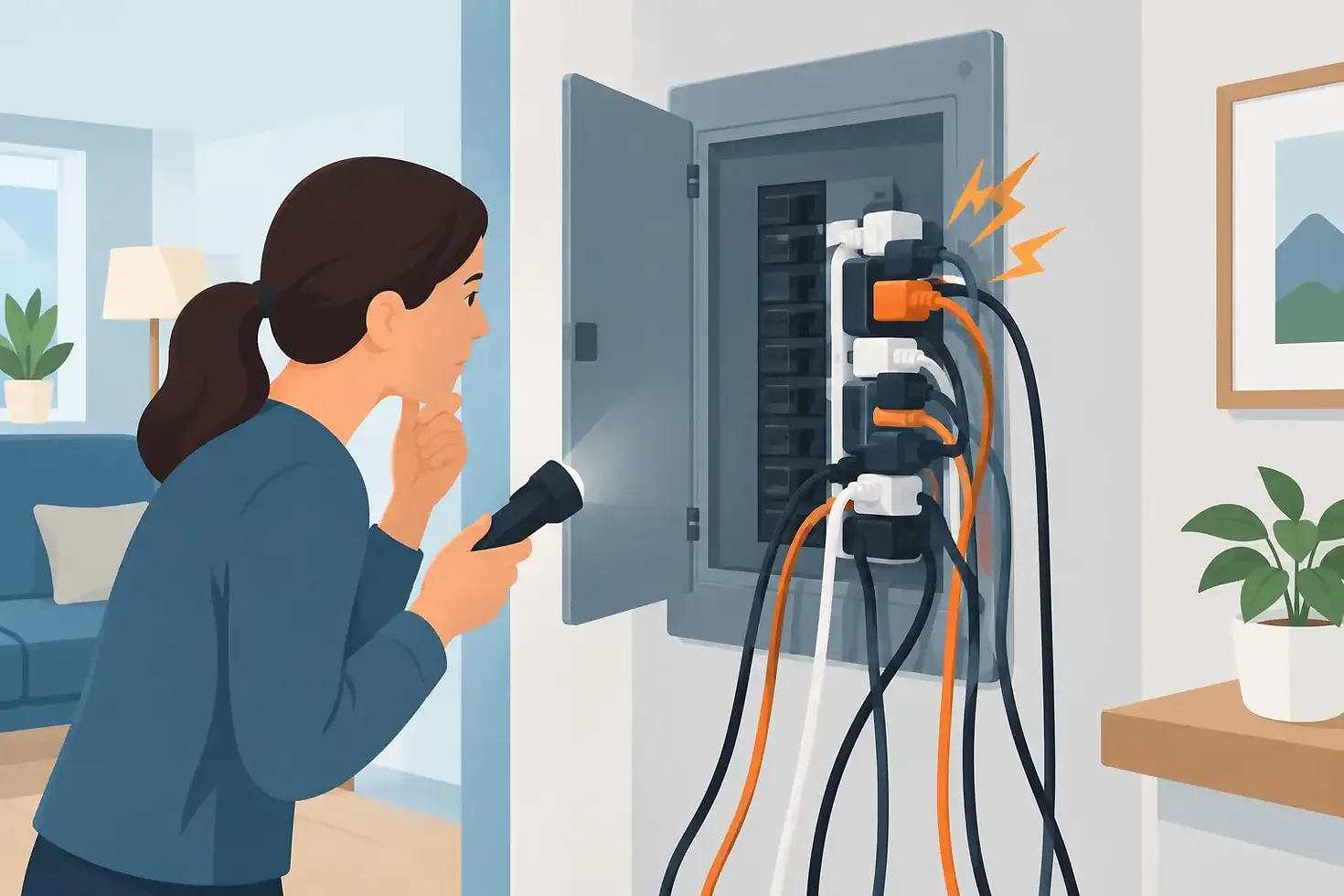
Extension leads and power boards can hide the real problem. A power board does not create more available power. It simply lets more appliances draw from the same outlet and, often, the same circuit. Daisy-chaining power boards or extension leads is particularly risky because it can overload the leads and connections before the circuit breaker responds.
How to identify overloaded circuits safely
You can observe a few things without touching wiring or opening the switchboard. Keep a short note of the time, what was operating, which area lost power and whether a breaker or safety switch moved to the off position. This gives an electrician a far clearer starting point than simply saying that the power keeps going out.
If a breaker has tripped, turn off or unplug the appliances on the affected circuit before resetting it. Reset it once. If it stays on with appliances disconnected but trips again when several items are used, that supports the overload diagnosis.
If the switch will not reset, trips immediately, or an outlet shows heat, scorching, smoke, crackling or a burning smell, stop there. Do not keep resetting it in the hope it will hold. Do not remove the switchboard cover, replace a breaker, or attempt to repair a power point yourself. In Western Australia, fixed electrical work must be completed by a licensed electrical contractor.
Know the difference between a breaker and a safety switch
People often call every trip a “safety switch trip”, but the device that has operated matters. A circuit breaker is designed to protect wiring from overcurrent, including overloads and short circuits. A residual current device, often called an RCD or safety switch, is designed to help protect people from electric shock by detecting current leakage.
A tripped circuit breaker after several appliances are used points more strongly towards overload. An RCD that trips may indicate a faulty appliance, damaged cord, moisture or another electrical fault. Some switchboards use combined devices that perform both jobs, so the answer is not always obvious from the switchboard alone. Either way, frequent tripping needs proper investigation.
Why repeated tripping is not a fixable inconvenience
It can be tempting to reset the breaker, shift one plug and get on with the day. The risk is that the underlying problem may gradually worsen. Loose terminals, worn outlets and damaged cords generate heat, and heat can damage insulation or create a fire hazard.
Repeated trips can also disrupt refrigeration, security systems, internet equipment and business operations. For landlords and property managers, a recurring electrical complaint should be treated as maintenance with safety implications, not just an inconvenience for the tenant. A clear record of when it occurs and which appliances are involved can speed up the repair process.
Older homes are especially worth checking. They were not always designed around the number of appliances now used every day. A renovated kitchen, home office, EV charger, pool equipment or added air conditioning can change a property’s electrical demands significantly. The same applies to sheds converted into workshops or business spaces where equipment has grown over time.
When the answer is an upgrade, not a workaround
Sometimes the practical solution is simply changing how appliances are used. Staggering high-demand items can prevent unnecessary trips in a sound electrical installation. But this is not always realistic, particularly for busy families, rental properties, cafés, offices and workshops.
If a circuit is regularly overloaded under normal use, an electrician may recommend additional circuits, new dedicated outlets, a switchboard upgrade or dedicated supply for fixed equipment. The right option depends on the condition of the existing wiring, the switchboard capacity, the appliance load and how the space is used. Adding a larger circuit breaker without checking the cable and installation is unsafe and is never a DIY solution.
A qualified electrician can test the circuit, inspect outlets and connections, identify whether an appliance fault is involved and explain the most sensible repair or upgrade. It is usually better value to address the cause than repeatedly replace damaged power boards, lose stock in a fridge outage or put up with unreliable power.
A sensible next step for Perth properties
If you are in Fremantle, Cockburn, Melville, Henderson, Naval Base or Perth’s southern suburbs and a circuit keeps tripping, treat the pattern seriously. General Power can inspect the issue, identify whether the cause is overload or a fault, and provide a clear quote for any repair or upgrade needed.
Your home or business should cope with ordinary daily use without hot outlets, stressed power boards or regular trips. If it does not, leave the switchboard work to a licensed electrician and get the cause sorted before the next busy morning exposes it again.


Comments